

Hire cost effective Remote Patient Monitoring Assistants with great communication skills who are willing to work in your time zone
We’ll help you find the ideal candidate and provide support through the onboarding process
We review hundreds of candidates each week and only accept the top 2%
No hidden fees or long term contracts

George reached out to me on LinkedIn, and while I rarely respond to cold outreach offering services, his approach felt thoughtful and genuine, so I decided to explore what his firm had to offer. We’ve been considering offshore talent for several years but hadn’t made the leap, as we hadn’t found the right offshore partner. Recently, we started working with Ataraxis, and it’s been a fantastic experience—they quickly sourced an exceptional contractor for our recruiting team and ran a smooth, efficient process from start to finish.

I was pretty hesitant about hiring people offshore, but had a fantastic experience working with Ataraxis to hire a virtual recruiter for my business. They connected me with Anabel, who’s based in the Philippines and has been incredible—she’s extremely hard-working, quick to learn, and always brings a great attitude to her work. Now I’m thinking about how I can build a team around her.
The entire process with Ataraxis has been seamless, and they regularly check in to make sure I’m happy with the service they’ve provided. It’s clear they truly care about their clients’ success. I highly recommend Ataraxis to anyone looking to grow their team with quality talent!

Highly Recommend!
I had the absolute pleasure of working with George, and I can confidently say that his expertise and guidance have been game-changing for my business. On our first conversation, George provided clear, actionable strategies tailored to my recruitment challenges. His deep industry knowledge, tested outreach methods, and data-driven approach set him apart.
If you’re a recruiter or business owner looking for expert-level guidance on client acquisition, outreach, and recruitment processes, I highly recommend working with George. His advice is practical, results-driven, and delivered with professionalism and genuine care for your success.
Thank you, George, for your time, insights, and the motivation to push forward with confidence!

I made a hire through Ataraxis a few months ago.
As it goes in any hiring process, when you meet the right person, you know immediately. I knew when I met the 5th candidate that she’d be the one.
3 weeks into her job she had a fundamental mastery of her own responsibilities. 2 weeks later, she assumed a whole new set of responsibilities on top of that. And now she’s a fully integrated part of my team.
10/10 will work with Ataraxis again.

George and his team did a fantastic job placing a Talent Sourcer on my team. She’s smart, communicates well, works diligently, and is a self-starter. Bonus points, her background (10 years!) is in an industry directly adjacent to ours. As such, she was able to catch on extremely fast and onboarding her was a breeze. My only gripe is that I wish I had taken this on sooner. Thanks Ataraxis!

George has been a great help throughout this process, which was new to us. His team sourced some great candidates for us to choose from, and we are really happy with our hire. George has also conducted regular check-ins and follow-ups. He is happy to share his personal insights and experience around structuring the job description, onboarding, and getting the best out of this recruitment process. I would definitely recommend George and his business for VA solutions.
Hiring remote patient monitoring (RPM) assistants through Ataraxis provides HIPAA-trained support at a fraction of U.S. salaries, handling device setup and vitals dashboards, patient outreach and escalations, and improving adherence and reimbursements while overhead stays low.

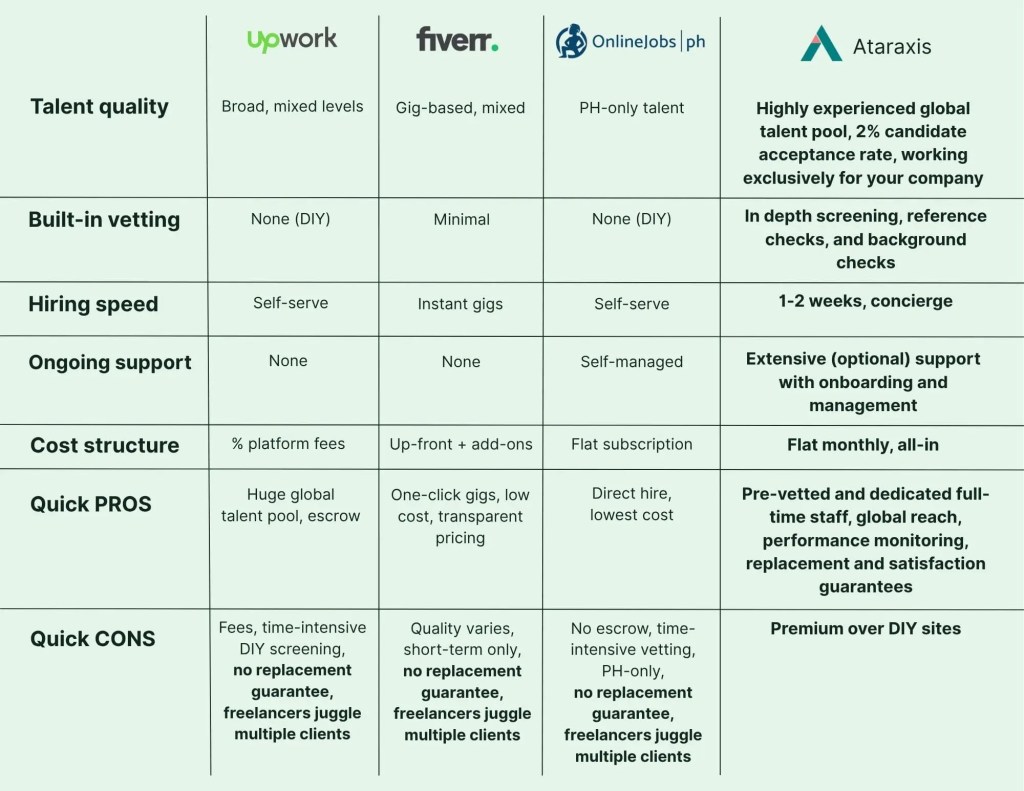
Here’s how remote patient monitoring assistant companies like Upwork, Fiverr, OnlineJobs.PH, and Ataraxis compare on key hiring criteria.

MBA, with 8 years of experience in healthcare, finance, and HR

MBA, with 9 years of experience in marketing, accounting, and professional services

Master’s degree, with 8 years of experience in finance, software, and consulting

MBA, with 12 years of experience in manufacturing, real estate, and hospitality

A Remote Patient Monitoring (RPM) Assistant supports healthcare providers by tracking patient health data through connected devices and ensuring timely follow-ups. They help improve care quality, reduce hospital readmissions, and keep patients engaged in their treatment plans while maintaining HIPAA compliance.
A Junior RPM Assistant typically has 0–2 years of experience and provides basic support in monitoring patient health data collected through remote devices. They assist with tracking vital signs, updating electronic health records (EHR), and notifying providers of abnormal readings under supervision. Familiar with HIPAA compliance, medical terminology, and digital health platforms, they focus on accuracy and timely communication.
Ideal for practices needing entry-level support to manage daily patient monitoring tasks.
With 2–5 years of experience, a Mid-Level RPM Assistant independently manages patient monitoring workflows, including reviewing data dashboards, following up with patients, troubleshooting device issues, and ensuring data accuracy. They are skilled in using RPM platforms, coordinating with care teams, and providing patient education on device usage. Proficient in identifying trends and escalating concerns, they help providers deliver proactive care.
Perfect for organizations seeking professionals who can ensure smooth RPM operations while enhancing patient engagement.
A Senior RPM Assistant brings 5+ years of experience and excels in overseeing RPM programs, managing large patient populations, and ensuring compliance with clinical and regulatory standards. They are experts in interpreting RPM data, coordinating care plans, and implementing best practices to improve outcomes. Senior RPM Assistants often mentor junior staff, optimize monitoring workflows, and collaborate with leadership to expand digital health services.
Ideal for healthcare organizations seeking a seasoned professional to lead remote monitoring efforts and strengthen patient care delivery.
Your ideal Remote Patient Monitoring Assistant should bring clear communication, strong attention to detail, and a solid understanding of clinical workflows and device protocols. You should enjoy working closely with them, knowing they are focused on enrolling patients, setting up devices, reviewing vitals dashboards, documenting interventions, coaching adherence, escalating alerts based on clinical rules, updating the EHR, and coordinating with billing and care teams. They will use secure RPM platforms, patient messaging tools, and organized checklists to keep readings accurate and follow-ups on time.
Hiring the right RPM Assistant reduces missed alerts and manual tracking, improves patient engagement, and supports timely interventions. The result is better outcomes, steadier RPM revenue, and more time for your providers to focus on care and practice growth.
Guide patients on how to set up and use RPM devices (e.g., blood pressure cuffs, glucometers).
Review patient-generated health data daily for abnormalities or trends.
Flag critical readings and escalate to providers when necessary.
Contact patients for reminders, troubleshooting, or clarifications.
Record patient data, alerts, and interactions in the EHR system.
Ensure monitoring aligns with HIPAA and payer program requirements.
Assist patients with device connectivity or usage issues.
Schedule provider follow-ups based on RPM data trends.
Educate patients on managing chronic conditions using RPM tools.
Generate reports on patient adherence, outcomes, and engagement.
Work closely with providers, nurses, and care teams to support proactive interventions.
Track program performance and suggest improvements for efficiency.
Enable proactive care through continuous monitoring and early interventions.
Free providers from routine monitoring tasks while ensuring nothing is missed.
Reduce hospitalizations and emergency visits with preventive care support.

Ataraxis does the heavy lifting by thoroughly screening and vetting RPM assistants before they’re matched with you. This means you won’t waste time sorting through unqualified candidates.

Ataraxis RPM assistants are fluent in English and skilled at communicating professionally, ensuring there’s no miscommunication in your day-to-day tasks.
Unlike many freelancers who may not align with your work hours, Ataraxis RPM assistants are willing (and happy) to work in your time zone, making collaboration seamless.

All Ataraxis RPMs are college educated and have specialized experience in various fields, so you can trust them to hit the ground running.
Hiring through Ataraxis gives you access to ongoing support. If your team of RPM assistants needs adjustments, Ataraxis is there to help, unlike freelancer platforms where you’re on your own.

Freelancer platforms often attract short-term gig workers who juggle multiple client projects at the same time. Ataraxis RPM assistants are committed to building lasting partnerships with one employer, becoming a true extension of your team.
When you’re ready to hire a Remote Patient Monitoring Assistant, the best location depends on the mix of cost, language skills, time-zone overlap, and talent depth your business needs. Here’s a quick tour of the best regions, each with clear advantages and a few trade-offs, to help you decide where to hire a Remote Patient Monitoring Assistant who fits your workflow.
Pros:
It’s no surprise that many business owners choose to hire a Filipino remote patient monitoring assistant. Candidates from this region have strong English proficiency, familiarity with western business culture, and experience working for U.S. clients. 24/7 support is also easy because night-shift work is common.
This region excels in customer service, lead generation, virtual assistance, data entry, bookkeeping, medical billing, and healthcare administrative support.
Cons:
Increasing demand for Filipino RPMs is slowly pushing wages up and internet outages during typhoon season occasionally interrupt service.
*Ataraxis remote patient monitoring assistants from this region have power and internet backups to minimize service interruption and are willing to work in your time zone.
Pros:
Near-shore time zones mean you can hire a remote patient monitoring assistant who works the same hours as your U.S. team, reducing lag on urgent tasks. Businesses with a large Spanish-speaking customer base may also benefit from hiring bilingual virtual assistants.
This region excels in sales development, business development, digital marketing, customer success, and account management.
Cons:
Hourly rates are much higher and the talent pool is much smaller compared to the Philippines and other regions.
Pros:
Highly educated, English-first workforce with a neutral accent, which is a big plus for phone-based support, especially for U.K. and Australian companies. South Africa overlaps with U.S. mornings and U.K. afternoons, which is ideal for trans-Atlantic operations.
This region excels in virtual assistance, healthcare administrative support, sales development, business development, digital marketing, customer success, content moderation, and account management.
Cons:
Cost of talent sits between Latin America and the Philippines, trimming, but not eliminating, cost savings.
Pros:
Rapidly growing BPO sector that is less competitive compared to the Philippines and Latin America. Top candidates from this region have accents that are almost indistinguishable from U.S. based staff.
This region excels in virtual assistance, executive assistance, software engineering, accounting, data entry, social media management, and business development.
Cons:
Infrastructure and internet reliability still improving outside major hubs.
Pros:
Near-shore location for U.S companies delivers real-time collaboration for East-Coast teams and fluent English support. Very competitive operating costs versus onshore hires.
This region excels in customer service, BPO call centers, healthcare claims, technical support, and help desk support.
Cons:
Smaller population means fewer specialised RPMs, so scaling a large team may be harder. Hourly rates trend closer to Latin American levels given limited supply.
Pros:
Countries in this region are well-known for high education levels and strong work ethic. Arguably, the deepest talent pools for technical roles and has an ideal time zone overlap for European companies.
This region excels in software engineering, quality assurance, DevOps, data analytics, and other technical roles.
Cons:
Costs are much higher than the Philippines, East Africa, and time zone differences may be a bigger obstacle for U.S. companies.
Hiring your first remote patient monitoring assistant is perfectly doable on your own, but most business owners underestimate the hours it takes to sift through resumes, schedule calls, and run multiple interview rounds. Research shows that the DIY path typically drags on for weeks (or months), involves several interviews, and can still lead to mis-hires if you rush the vetting stage.
List everything you want your remote patient monitoring assistant to own and create detailed instructions. Clarifying scope upfront helps with long term retention and minimizes confusion.
Having a set schedule helps create structure and consistency.
Write a descriptive JD with required experience, KPIs, schedule expectations, etc.
Post your job description to RPM assistant websites and craft a recruitment message you can use to reach out to candidates directly.
Expect to screen 40-100 candidates to find your ideal virtual assistant.
Give 2-3 finalist candidates a short take-home assignment to test their attention-to-detail, responsiveness, and work product.
A bad hire can cost up to 50% of first-year pay, so doing your due diligence is cheap insurance.
Draft an employment or contractor agreement, include an NDA, and grant tool access.
When you hire a remote patient monitoring assistant through Ataraxis, you skip steps 2-7, saving you weeks of lost productivity.
A Remote Patient Monitoring (RPM) Assistant is a healthcare support professional who helps providers track and manage patients’ health data collected through remote monitoring devices. They handle the administrative, technical, and communication tasks that ensure timely interventions and better patient outcomes.
Managing RPM programs can be time-consuming for clinical staff. A Virtual RPM Assistant ensures accurate data collection, patient compliance, and timely reporting, which allows your clinical team to focus on care decisions rather than administrative follow-up.
By ensuring patients consistently use their monitoring devices and by tracking data closely, RPM Assistants help providers catch health concerns early, leading to proactive care and fewer hospital visits.
Yes. They can efficiently manage data from multiple patients, flagging urgent cases while keeping routine monitoring on track. This makes RPM programs scalable and cost-effective.
They ensure RPM documentation meets payer requirements, which allows practices to bill for RPM services accurately. Their work helps maximize reimbursements from Medicare and commercial insurers.
Yes. They are trained to handle sensitive patient health data in compliance with HIPAA standards, using secure communication tools and maintaining strict confidentiality.
They use secure phone calls, patient portals, or HIPAA-compliant messaging systems to remind patients about device use, answer questions, and escalate abnormal readings to providers.
Hiring a remote patient monitoring assistant saves money compared to having full-time office staff. This lets you and your team focus more on growing your business and doing what you do best.
Great remote patient monitoring assistants often come from countries and regions like the Philippines, South Africa, Latin America, East Africa, and Eastern Europe. These countries are known for their skilled workers who speak fluent English and have strong work ethics.
Yes! At Ataraxis, your remote patient monitoring assistant will match your local time zone, making teamwork easy and smooth.
US-based remote patient monitoring assistants usually cost $25 to $50 per hour. Ataraxis offers MBA-level, full-time remote patient monitoring assistants starting at just $11 per hour. This means you get great help for up to 70% less.
We keep your information safe by using secure VPN connections, regular monitoring, and privacy agreements signed by every virtual assistant.
Payments are easy and secure with Stripe. We also promise 100% satisfaction – if you’re not happy, we’ll fix it right away.
Ataraxis only offers full-time RPM assistants because they provide more consistent help, become part of your team, and show greater commitment.
Ataraxis uses software to monitor your assistant’s activities, ensuring they are always working efficiently and staying productive.
It’s best to set up clear communication methods right from the start. You can use popular tools like Slack, WhatsApp, Zoom, or email, based on what works best for you.
Your satisfaction is our #1 priority. If you’re not happy, we’ll quickly address the issue and find you a better match, or issue a prorated refund if needed.
Great communication skills, attention to detail, strong work ethics, time zone alignment, work from home readiness, and problem solving skills. We carefully choose assistants based on their skills, experience, availability, and special abilities to make sure they match your business needs.
Yes! Many businesses find remote patient monitoring assistants deliver even better quality work, especially for specialized tasks.
Paying very low rates, like $2-3 per hour, usually means getting less skilled workers and lower quality work. Ataraxis offers affordable assistants who are highly skilled.
It usually takes 1-2 weeks to get your remote patient monitoring assistant fully onboarded and familiar with your business, ensuring you work well together from the very beginning.