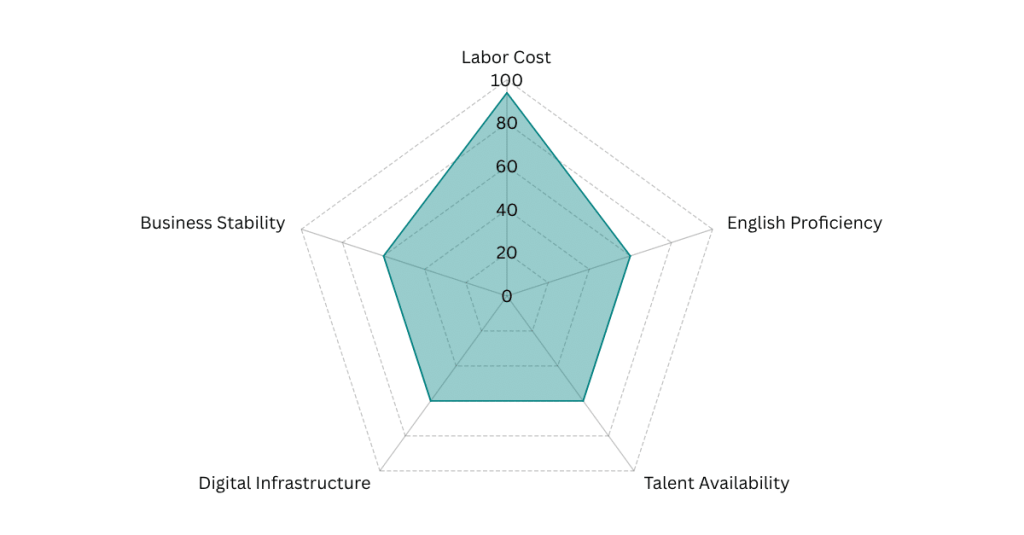
Morocco is one of the most cost-effective outsourcing destinations in Africa and the MENA region right now. Labor costs are extremely low, which means your budget stretches much further here than in most other countries. The country has a well-established outsourcing sector that already serves clients in France, Spain, and the rest of Europe. English proficiency is growing quickly but sits at a moderate level, so it is worth factoring that into the roles you hire for. Morocco works best for French-speaking businesses, European time zones, and back-office or IT roles where day-to-day communication is structured.
Each country receives a 0-100 score per factor, weighted by importance. Scores are derived from publicly available datasets and expert interpretation, using sources such as LinkedIn, UNESCO, EF EPI, World Bank, and the International Telecommunication Union (ITU).
The index is comparative and neutral, designed to highlight relative strengths rather than label any country as “good” or “bad.”
Time Zone: Western European Time (WET) / UTC+0, or UTC+1 during daylight saving time (WEST)
Current Local Time:
Morocco is aligned closely with Western Europe, making it one of the most convenient outsourcing destinations for UK and European businesses. For US-based companies, your Morocco team can start their day before you wake up and have work ready for you by the time you log on in the morning.
For UK businesses, the overlap is almost perfect. For European teams, Morocco sits in the same time zone or just one hour behind, which makes real-time collaboration very straightforward. For US-based teams on Eastern Time, there is a 4-5 hour difference, which still allows for a meaningful window of overlap during the afternoon hours.

Moroccan professionals have a strong track record in customer-facing roles, back-office support, and digital services. The country has been an outsourcing hub for European companies for over two decades, with a focus on French-speaking markets. That base is now expanding into English-language roles and higher-value IT and knowledge work.
Commonly outsourced roles include:
These roles work well in Morocco because of the country’s established outsourcing infrastructure and a large pool of university-educated professionals. The BPO sector employs around 150,000 workers and has direct experience serving clients in France, Spain, Belgium, and increasingly in the UK and US markets. The government is actively expanding the sector under its Digital Morocco 2030 plan, which targets 130,000 new jobs and $4 billion in service exports by 2030.
National holidays: Morocco observes several national holidays each year. Plan ahead so these do not catch you off guard:
Religion & customs: Morocco is a predominantly Muslim country. Ramadan is the most significant religious period of the year, typically lasting about a month. During Ramadan, working hours may shorten and your team’s energy levels can vary, especially toward the end of the day. Plan around this if your work is deadline-sensitive. Eid al-Fitr and Eid al-Adha are the two biggest holidays and usually involve extended time off of 2-3 days each. Moroccan professionals are generally formal, respectful, and value relationship-building. Taking a few minutes at the start of a call to check in goes a long way.
Outsourcing work culture: Morocco has been an outsourcing destination for European companies since the early 2000s. There is real infrastructure here, not just talent. Workers are accustomed to shift schedules, meeting international deadlines, and working with remote teams from other countries. The culture values hard work and professionalism. Many workers in major cities like Casablanca and Rabat have direct experience working for French, Spanish, or German clients, which means they already know what international standards look like.
Communication style: Moroccan professionals tend to be polite and may soften difficult feedback rather than say something directly. Creating an environment where your team feels comfortable raising issues early will save you time. Clear written instructions, documented processes, and regular check-ins work best. For French-speaking clients, communication is typically very smooth. For English-only teams, it is worth screening candidates on written English skills, especially for roles like customer service or content work.
Infrastructure variability: Internet reliability is generally good in major cities like Casablanca, Rabat, and Marrakech. Power outages are infrequent but can occur. When hiring, confirm that candidates have a reliable internet connection, ideally with a mobile hotspot as a backup, and an uninterrupted power supply (UPS) at their workspace.
Weather considerations: Morocco experiences hot, dry summers and mild winters. Coastal cities like Casablanca and Rabat are cooler year-round. Extreme heat in inland areas during summer months can occasionally affect productivity, but this is rarely a significant disruption for remote workers in well-equipped home or office setups.
Risk mitigation when hiring: When bringing on remote staff from Morocco, confirm that they have a reliable internet connection with a mobile hotspot backup, an uninterrupted power supply or inverter at their workspace, and a quiet professional setup for video calls. Running a short paid test project before committing to a hire is a smart way to verify the setup and workflow.
Business risk level: Low to Moderate
Morocco has one of the most stable political and business environments in Africa. It is a constitutional monarchy with functioning legal institutions and a well-established framework for foreign businesses. The country has trade agreements with the US, EU, and several African nations. For straightforward remote work and outsourcing, the risk level is low. Setting up local entities or handling complex contracts can take time, but working through an established staffing partner keeps things simple.
Data & compliance: Morocco has its own data protection framework under Law 09-08, which is broadly aligned with European standards. If your business handles sensitive data such as healthcare records, financial information, or legal documents, set clear data security rules with your team from day one. Make sure staff use secure tools, sign confidentiality agreements, and follow your company’s data handling policies regardless of local requirements.