
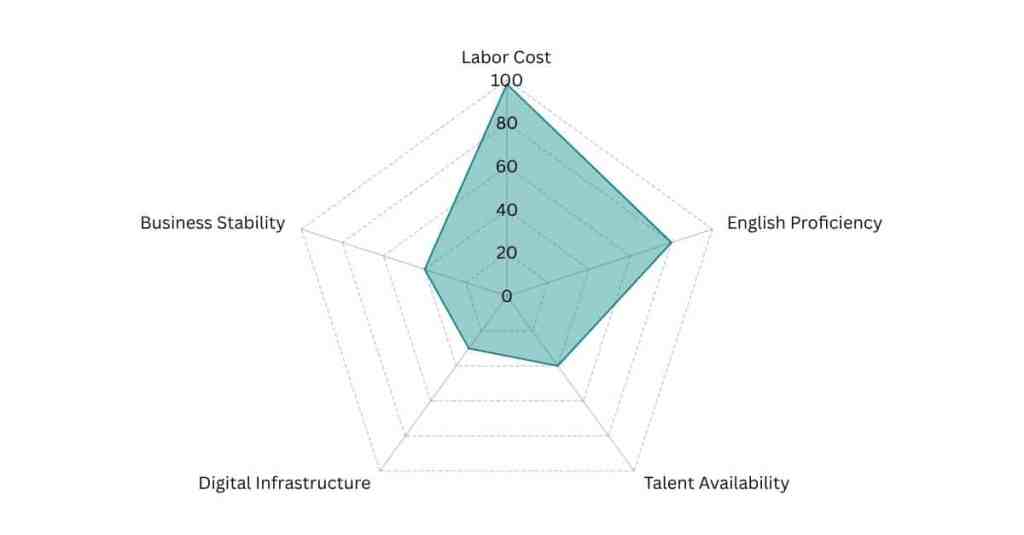
Uganda is one of the most affordable places to hire remote talent right now. The country scores near the top for labor cost, which means your budget goes a long way here. English is an official language and is used in schools, government, and business, so communication on most tasks is straightforward. The talent pool is still developing compared to more established outsourcing markets, and digital infrastructure is a real factor to plan around. That said, for the right roles, Uganda can be a smart, low-cost option that not many businesses are tapping into yet.
Each country receives a 0-100 score per factor, weighted by importance. Scores are derived from publicly available datasets and expert interpretation, using sources such as LinkedIn, UNESCO, EF EPI, World Bank, and the International Telecommunication Union (ITU).
The index is comparative and neutral, designed to highlight relative strengths rather than label any country as “good” or “bad.”
Time Zone: East Africa Time (EAT) is UTC+3
Current Local Time:
Uganda is 3 hours ahead of UTC. For US-based businesses on the East Coast, Uganda is 8 hours ahead, so your Uganda team can start work, complete deliverables, and have them ready for review before your day even begins. For UK businesses, the overlap is workable, especially for morning shifts. For Australian businesses, the time difference is significant, but async workflows can make it manageable.

Uganda’s outsourcing strengths sit in administrative, back-office, and digital support roles. The country’s strong English base and low labor costs make it a good fit for tasks that require clear communication and reliability without a large budget.
Commonly outsourced roles include:
These roles work well in Uganda because of the country’s English-medium education system, its growing pool of university-trained young professionals, and a workforce that is increasingly familiar with remote work tools and global clients. Roles that are more dependent on advanced technical infrastructure or deep specialist pipelines are better served by markets with higher Talent Availability scores.
National holidays: Uganda observes the following public holidays each year. Plan your project timelines around these so you are not caught off guard:
Religion & customs: Uganda has a mix of Christian and Muslim communities. Christmas, Easter, Eid al-Fitr, and Eid al-Adha are all significant, and some workers may take extended time off around these periods. If your work is deadline-sensitive, it is worth having a conversation with your team about their schedules ahead of these dates. Ugandan professionals are generally warm, respectful, and relationship-oriented. Taking a few minutes at the start of a call to check in goes a long way in building a solid working relationship.
Outsourcing work culture: Remote work is growing in Uganda, particularly among younger professionals in Kampala. Freelancing platforms have become popular, and a segment of the workforce has real experience serving clients in North America, Europe, and the Gulf. That said, Uganda does not yet have the same scale of outsourcing infrastructure as markets like the Philippines or India, so you may need to invest a bit more time in onboarding and setting up clear processes. Workers who have remote experience tend to adapt quickly once expectations are clearly set.
Communication style: Ugandan professionals are typically polite and may be hesitant to push back directly, even when they need clarification. The best thing you can do is create a working environment where asking questions is encouraged. Providing written SOPs, clear task briefs, and regular check-ins from the start will reduce misunderstandings and help your team deliver what you actually need.
Infrastructure variability: Internet reliability is strongest in Kampala and other major towns. Outside of urban areas, connectivity can be patchy and power outages are not uncommon. When interviewing candidates, it is worth asking about their internet setup, whether they have a backup mobile data connection, and whether they have access to an uninterrupted power supply (UPS). These are simple checks that can save a lot of headaches later.
Weather Considerations: Uganda has two rainy seasons, roughly March to May and October to November. Heavy rains can occasionally cause localized disruptions, though this is rarely severe enough to impact remote work for extended periods. For project-sensitive work, it is worth being aware of these windows.
Risk mitigation when hiring: When bringing on remote staff from Uganda, it is a good idea to confirm that they have a reliable internet connection (with a mobile hotspot as backup), a UPS or alternative power source at their workspace, and a professional setup for video calls. These are not deal-breakers for most candidates in Kampala, but they are worth confirming upfront.
Business risk level: Moderate to High
Uganda has a relatively stable political environment by regional standards, but the business and legal framework is still developing. For remote service-based outsourcing, this is generally manageable. Setting up local entities or entering formal supplier agreements can carry added complexity. Working through established platforms or staffing partners reduces your exposure here considerably.
Data & compliance: Uganda passed the Data Protection and Privacy Act in 2019, but enforcement is still maturing. If your business deals with sensitive information like healthcare records, financial data, or legal documents, make sure your remote team signs confidentiality agreements, uses secure tools, and follows your company’s data handling policies. Do not assume local regulations alone will cover your requirements.