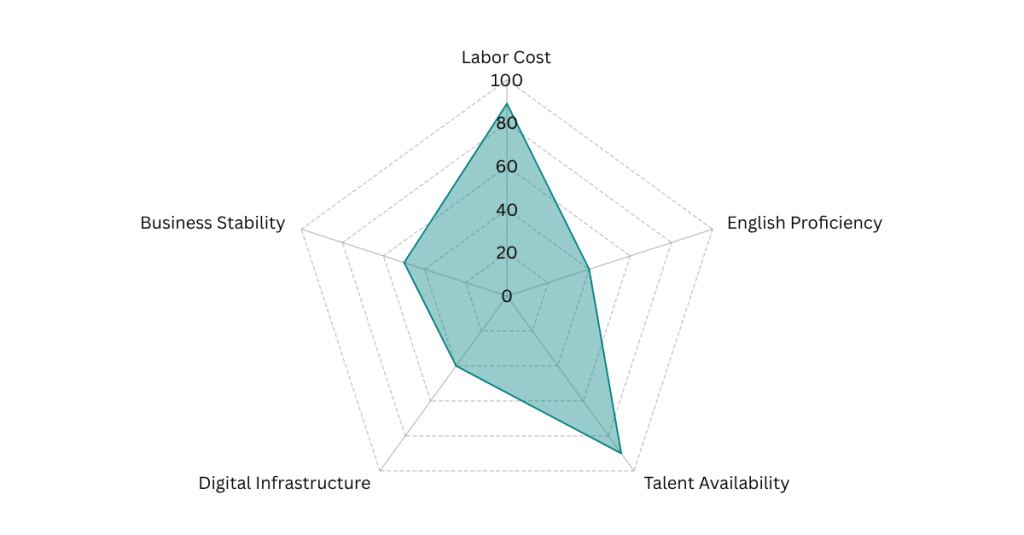
Turkey is a strong outsourcing destination for businesses that need skilled, technical talent at a significantly lower cost than what you would pay in Europe or North America. The country scores very high on labor cost and talent availability, with a large pool of university-trained professionals and a growing remote work culture. English proficiency and digital infrastructure are the areas to plan around, and the business and political environment carries some risk, but for the right roles, Turkey delivers real value that a lot of businesses are already tapping into.
Each country receives a 0–100 score per factor, weighted by importance. Scores are derived from publicly available datasets and expert interpretation, using sources such as LinkedIn, UNESCO, EF EPI, World Bank, and the International Telecommunication Union (ITU).
The index is comparative and neutral, designed to highlight relative strengths rather than label any country as “good” or “bad.”
Time Zone: Turkey Time (TRT) is UTC+3
Current Local Time:
Turkey sits 3 hours ahead of UTC and does not observe daylight saving time, so the offset stays the same year-round. For US East Coast businesses, the gap is around 7 to 8 hours depending on the time of year, which means your Turkey team can complete a full day of work and have deliverables ready before your business day starts. For UK and European businesses, the overlap is much more practical, with only a 2 to 3 hour difference that allows for real-time collaboration. For businesses in the Gulf region or South Asia, Turkey is practically in the same time zone.

Turkey’s outsourcing strengths sit in software development, IT services, finance, and back-office operations. Istanbul has a mature BPO sector that already serves clients across Europe and the Middle East, and the country’s large STEM graduate output means there is real depth in the technical talent pool.
Commonly outsourced roles include:
These roles do well in Turkey because of the large number of university-trained professionals and a growing remote work culture that accelerated significantly after 2020. The fintech, e-commerce, and software sectors have been especially active, which means there is a strong bench of talent in technical and digital roles that is already used to working with international clients.
National holidays: Turkey observes the following public holidays each year. Plan project timelines around them so they do not catch you off guard:
Religion & customs: Turkey is a predominantly Muslim country with a secular government. The two biggest religious holidays are Eid al-Fitr and Eid al-Adha. Teams often take extended time off around these dates, and business tends to slow down in the days leading up to them. If your work is deadline-sensitive, flagging these windows early in the year will save you from surprises. Turkish professionals are relationship-oriented, and a quick check-in at the start of a call or meeting goes a long way before getting into business.
Outsourcing work culture: Turkey has a well-established IT outsourcing sector, with major clients based in Germany, the UK, the Netherlands, and the Gulf region. Turkish professionals are used to working with international clients and adapting to different expectations. Remote work adoption stayed high after 2020, especially in tech, and there is real experience behind it. The BPO industry in Istanbul in particular has been growing steadily, serving as a nearshore hub for European businesses that want quality at a lower price point.
Communication style: Turkish professionals can be formal in early communications and tend to build rapport before getting straight into work. Some may be hesitant to push back or flag problems directly, so creating an open, question-friendly environment from day one matters. Clear written SOPs and expectations from the start reduce back-and-forth and help your team deliver what you actually need.
Infrastructure variability: Connectivity is strong in Istanbul, Ankara, and Izmir, but can be less consistent in smaller cities and rural areas. When hiring, ask candidates about their internet setup and whether they have a backup connection. Mobile data coverage is wide, so a hotspot as a backup is usually easy to arrange.
Economic conditions: Turkey has been dealing with elevated inflation in recent years. The government has been working to bring it under control, and the situation has been improving. For you as a hiring business, this works in your favor on labor costs, since salaries in USD or EUR terms remain very competitive compared to Western markets. That said, be aware that workers may look to adjust compensation over time as local conditions evolve.
Risk mitigation when hiring: When bringing on remote staff from Turkey, it is a good idea to confirm that they have a reliable internet connection, ideally with a mobile hotspot as a backup, and a quiet, professional setup for video calls. Asking these questions upfront saves you from operational issues later.
Business risk level: Moderate
Turkey carries moderate political and business risk. For remote work and service-based outsourcing, this is generally manageable. Setting up local entities or running contracts through Turkish suppliers involves more complexity and is worth working through an established staffing partner. For straightforward remote hiring, the practical risk is much lower.
Data & compliance: Turkey has data protection laws under the Personal Data Protection Law (KVKK), which is aligned with GDPR principles. The framework is established, though enforcement can vary. If your business handles sensitive information such as healthcare records, financial data, or legal documents, set clear data security rules with your team from day one. Make sure staff use secure tools, sign confidentiality agreements, and follow your company’s data handling policies regardless of what local law requires.