
Romania is a premier destination for high-complexity outsourcing in Europe, distinguished by its exceptional English proficiency and a highly technical workforce that balances cost-efficiency with EU-standard quality.
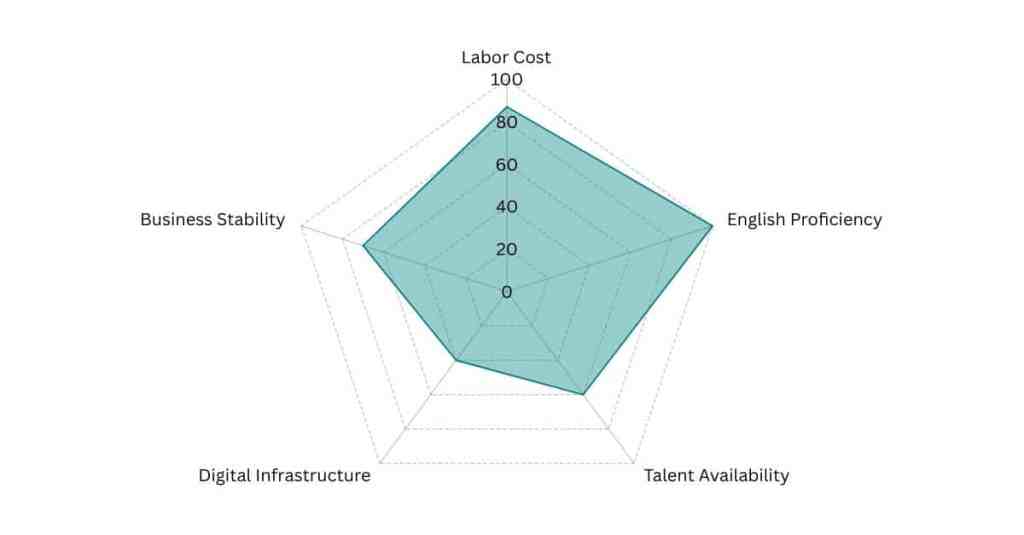
Each country receives a 0–100 score per factor, weighted by importance. Scores are derived from publicly available datasets and expert interpretation, using sources such as LinkedIn, UNESCO, EF EPI, World Bank, OECD, and the Heritage Foundation.
The index is comparative and neutral, designed to highlight relative strengths rather than label any country as “good” or “bad.”
Labor Force
Romania boasts a highly skilled and tech-centric labor force, with over 5.4 million professionals reachable on LinkedIn, reflecting a significant concentration in the IT and BPO sectors among its 1.3 million monthly active users.
Multilingual Edge
Romania is a “Multilingual Powerhouse” where nearly 99% of high school students study two or more foreign languages, allowing employers to easily scale teams fluent in English, French, Italian, and German. This linguistic versatility, rooted in Romania’s Latin heritage and strong German-language academic networks, makes the country a premier destination for high-value, multilingual BPO and tech operations.
English Proficiency Ranking
Ranked #11 globally and maintaining a “Very High Proficiency” status, Romania outpaces many of its regional peers. English is the primary language for the corporate tech and finance sectors, enabling seamless integration with Western teams.
Digital Infrastructure
With an internet penetration rate of 91.3% , Romania is among the most connected nations in the EU. While urban centers offer world-class gigabit speeds, national scores reflect a need for continued modernization in rural connectivity.
Time Zone: Eastern European Time (EET)
Current Local Time:
Romania is strategically positioned for nearshore support for Europe (1–2 hour difference) and provides a 7–10 hour overlap for U.S. East Coast companies, allowing for efficient “follow-the-sun” development and handovers.

The Romanian ecosystem is a hub for high-value knowledge work, particularly in engineering, multilingual support, and financial services. Commonly outsourced roles include:
Commonly outsourced roles include:
These roles leverage Romania’s reputation for technical rigor and its status as the “Silicon Valley of Transylvania.”
National holidays: Romania observes several religious and secular holidays where businesses typically close:
Religion & customs: Predominantly Orthodox Christian. The Easter and Christmas periods are the most significant, often involving “bridge days” granted by the government to connect holidays to weekends.
Outsourcing work culture: Romanian professionals are known for being proactive, solution-oriented, and highly adaptable. The culture is a mix of Western corporate standards and Eastern European directness.
Communication style: Direct and transparent. Romanians value competence and logic; they prefer straightforward feedback and clear technical specifications over excessive corporate pleasantries.
Infrastructure variability: Romania has some of the fastest broadband speeds in the world in major hubs like Bucharest, Cluj-Napoca, and Iași. However, secondary backup lines are still recommended for remote workers in smaller towns.
Regulatory Compliance: As an EU member, Romania is fully GDPR compliant. This significantly reduces legal friction for companies handling sensitive European or North American data.
Risk mitigation when hiring: Employers should screen for:
Business risk level: Low to Moderate
While bureaucratic friction exists, the legal framework is stable and aligned with European Union standards, making it a safe harbor for intellectual property.
Data & compliance: Because Romania is in the European Union, it follows the strict GDPR privacy laws, meaning offshore employers must handle all employee and customer data with high levels of security and transparency. For companies in healthcare or finance, this means using strong encryption, having clear privacy contracts, and following local rules on how personal information is stored and shared to avoid heavy fines.