
The Philippines ranks among the top-performing countries in the Global Outsourcing Talent Index due to its strong balance of cost efficiency, English proficiency, and large-scale talent availability, supported by a mature outsourcing ecosystem.
Each country receives a 0–100 score per factor, weighted by importance. Scores are derived from publicly available datasets and expert interpretation, using sources such as LinkedIn, UNESCO, TOEFL / EF EPI, Gallup World Poll, ITU, Ookla, World Bank, World Economic Forum, and the Heritage Foundation.
The index is comparative and neutral, designed to highlight relative strengths rather than label any country as “good” or “bad.”
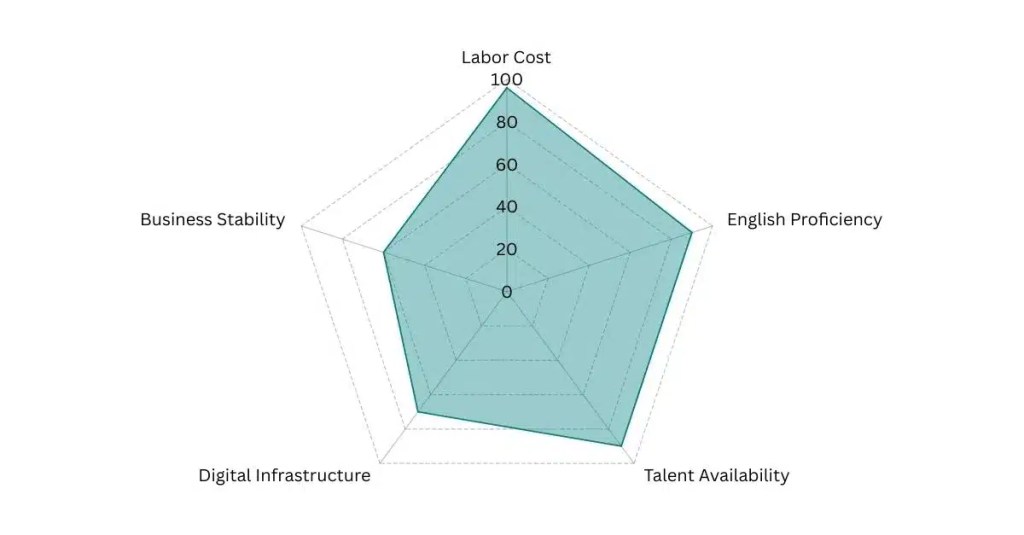
The Philippines offers a massive, searchable talent pool with over 7 million professionals on LinkedIn
Educational Pipeline
The country produces 1.45 million graduates annually from higher education and vocational programs, ensuring a continuous influx of skilled talent.
English Proficiency Ranking
Ranked #2 in Asia and #28 globally for English proficiency, the Philippines maintains a “High Proficiency” status, making it a premier hub for voice and complex support.
Digital Infrastructure
73.6% of the Philippines is online, with 86.98 million people making up a massive and growing digital community.
Time Zone: Philippine Standard Time (PHT)
Current Local Time:
The Philippines is well suited for overnight coverage, follow-the-sun support, and U.S. time-aligned shifts, particularly for customer service and operations roles.

The country’s outsourcing ecosystem supports a wide range of service and knowledge-based roles, especially those requiring strong English communication.
Commonly outsourced roles include:
These roles benefit from the Philippines’ large, university-educated workforce and service-oriented culture.
National holidays: The Philippines observes several major public holidays that can affect availability if not planned for, including:
Local and regional holidays may also apply depending on location.
Religion & customs: Predominantly Christian, with Christmas and Holy Week being the most culturally significant periods and often associated with extended leave.
Outsourcing work culture: The Philippines has a well-established outsourcing and BPO culture, and night shifts aligned to U.S. and European time zones are common and widely accepted. Many professionals are experienced working overnight schedules for global teams.
Communication style: Generally polite and indirect; clear documentation, written SOPs, and explicit expectations help reduce ambiguity and ensure alignment.
Infrastructure variability: Internet reliability is strong in major urban centers such as Metro Manila, Cebu, and Davao, but can be less consistent in provincial or rural areas.
Typhoon season: The Philippines is exposed to seasonal typhoons, typically from June to November.
Risk mitigation when hiring: Employers should screen for:
Business risk level: Moderate
Regulatory complexity and bureaucratic friction remain considerations, though they are generally manageable for service-based and remote-first operations.
Data & compliance: Employers should establish clear data security standards and compliance processes, particularly for regulated industries such as healthcare, finance, and legal services.