
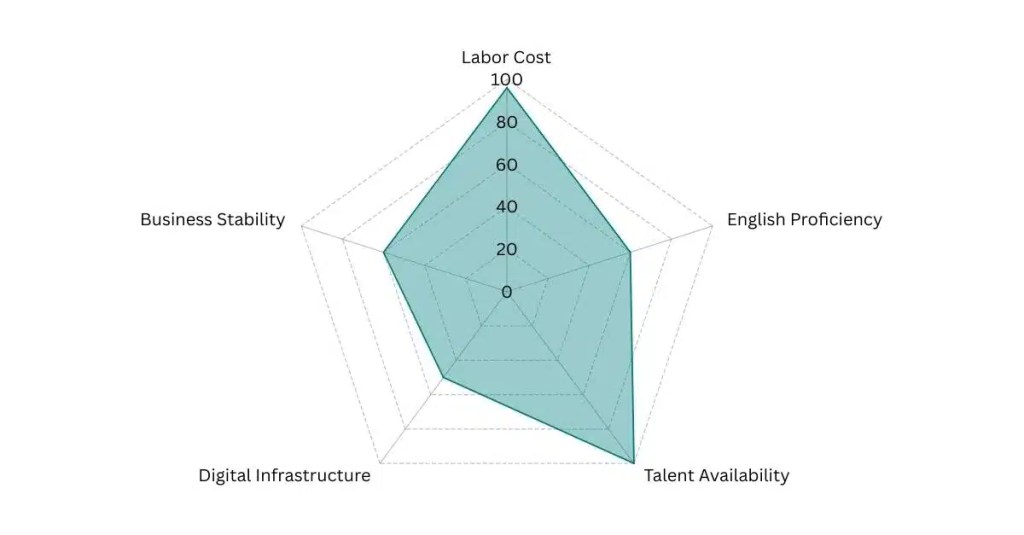
India ranks among the highest-scoring countries in the Global Outsourcing Talent Index due to its unmatched talent depth and extreme labor-cost efficiency. The country combines one of the world’s largest university-educated workforces with globally competitive wages, making it a cornerstone market for large-scale, skills-driven outsourcing.
Each country receives a 0–100 score per factor, weighted by importance. Scores are derived from publicly available datasets and expert interpretation, using sources such as LinkedIn, UNESCO, TOEFL / EF EPI, Gallup World Poll, ITU, Ookla, World Bank, World Economic Forum, and the Heritage Foundation.
The index is comparative and neutral, designed to highlight relative strengths rather than label any country as “good” or “bad.”
Talent Pool Depth
India offers one of the world’s deepest searchable graduate talent pools, with 160 million+ LinkedIn members
English Proficiency Trends
India received a score of 484, placing it in the “Low Proficiency” category and ranking 74th globally. Interestingly, the data shows that the highest proficiency within the country is found in the Research & Development (R&D) sector.
Digital Connectivity & 5G Rollout
India has seen a massive leap in mobile speeds due to 5G expansion. As of late 2025, the median mobile download speed reached 131.77 Mbps, a nearly 37% increase year-over-year. Furthermore, 5G coverage has now been detected in 77.8% of Indian villages, significantly narrowing the rural digital divide.
Adult Literacy Progress
India’s adult literacy rate (ages 15+) was updated upward to 81% in the 2024-2025 reporting cycle, a jump from 77% just two years prior.
Time Zone: India Standard Time (IST, UTC 5:30)
Current Local Time:
This makes India particularly effective for engineering, analytics, finance, and back-office operations that benefit from asynchronous workflows.

India’s outsourcing ecosystem supports high-volume, skills-intensive roles, especially those requiring technical, analytical, or process expertise.
Commonly outsourced roles include:
These roles benefit from India’s massive university graduate pipeline, strong STEM output, and long history of serving global enterprises.
National holidays: India observes several major public holidays that can affect availability if not planned for, including:
Additional state-specific holidays may apply depending on the employee’s location.
Religion & customs: India is religiously diverse (Hindu, Muslim, Christian, Sikh, and others). Major festivals like Diwali, Holi, and Eid are culturally significant and may involve extended leave in some regions.
Outsourcing work culture: India has one of the most mature outsourcing ecosystems in the world, with professionals who are highly experienced collaborating with U.S., UK, EU, and APAC teams. Night shifts and split schedules are widely accepted—particularly across IT, customer support, and operations roles—and many workers are deeply familiar with SOP-driven, metrics-based environments that emphasize consistency, documentation, and performance tracking.
Communication style: Generally direct and task-oriented, especially in technical and professional roles. Clear role definitions, written SOPs, and escalation paths help ensure consistency at scale.
Infrastructure variability: India is strongest in major hubs such as Bangalore, Hyderabad, Pune, Chennai, the NCR region, and Mumbai, where internet connectivity and power stability generally meet the needs of remote and offshore work. In contrast, smaller cities and rural areas can experience greater variability, making location and backup connectivity important considerations when hiring.
Connectivity considerations: Mobile internet in India is widely available and generally fast, making it a reliable fallback for remote work. However, fixed broadband quality can vary significantly by city and internet service provider, so connectivity standards and backup options should be evaluated during the hiring process.
Risk mitigation when hiring: Employers should screen for
Business risk level: Moderate
India is politically stable and economically resilient, but businesses should plan for regulatory complexity, state-by-state differences in enforcement, and slower legal and contract resolution timelines. These factors typically introduce operational friction rather than instability and are generally manageable for remote-first, service-based operations.
Data & compliance: Employers should implement clear data-handling policies, enforce role-based access controls, and apply strong security practices for regulated industries such as healthcare, finance, and legal services. When governance frameworks are clearly defined, India is well suited for compliant and secure operations.