
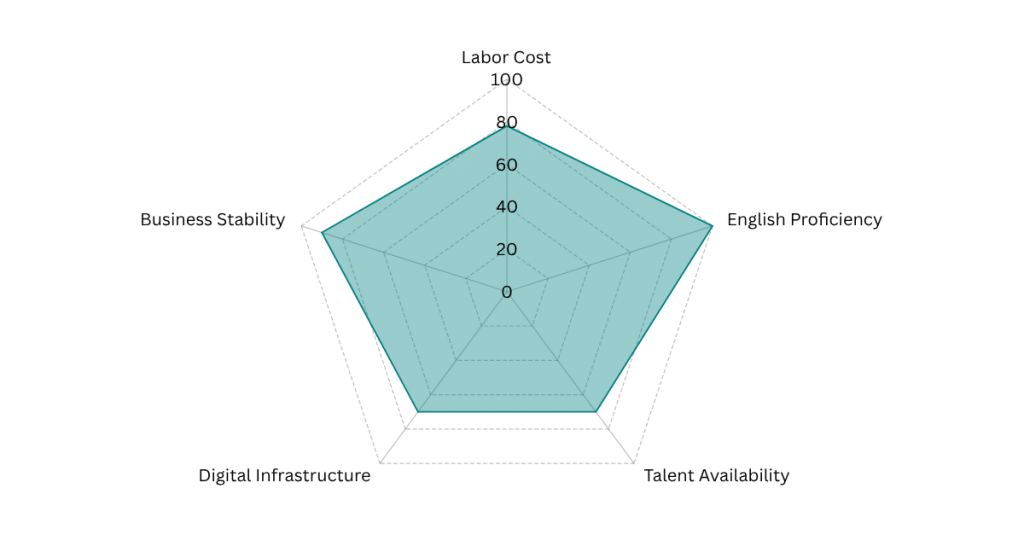
Poland is a premier destination in the European outsourcing landscape, distinguished by its elite technical talent, exceptional English proficiency, and a highly stable business environment. As a key hub for the European Union, it offers a sophisticated balance of high-end specialized skills and relative cost-efficiency compared to Western Europe.
Each country receives a 0–100 score per factor, weighted by importance. Scores are derived from publicly available datasets and expert interpretation, using sources such as LinkedIn, UNESCO, EF EPI, World Bank, and the Central Statistical Office of Poland (GUS).
The index is comparative and neutral, designed to highlight relative strengths rather than label any country as “good” or “bad.”
Labor Force
Poland boasts a robust and highly active professional landscape, with over 17.3 thousand employed persons.
Educational Pipeline
The country maintains a high-standard academic engine, producing approximately 292,000 graduates annually. A significant portion of these graduates specialize in Business, Administration, and law fields, ensuring a steady stream of high-tier talent.
English Proficiency Ranking
Ranked #15 globally and consistently maintaining a “Very High Proficiency” status, Poland outperforms most non-native English-speaking countries. It is a top-tier choice for complex project management and high-level corporate communication.
Digital Infrastructure
Poland features an advanced digital ecosystem with an 89.8% internet penetration rate. The country is a leader in fiber-optic expansion, providing median fixed download speeds of over 192 Mbps.
Time Zone: Central European Time (CET)
Current Local Time:
Poland is ideally positioned for European market alignment and provides a convenient “bridge” for U.S. East Coast operations, often used for overlapping shifts in software development and financial services.

Poland’s ecosystem is heavily geared toward high-value knowledge process outsourcing (KPO) and IT services.
Commonly outsourced roles include:
These roles leverage Poland’s reputation for technical excellence and its status as a multilingual hub for the EMEA region.
National holidays: Poland observes several statutory non-working days. If a holiday falls on a weekend, it is common practice for businesses to remain closed, though “giving back” a day off is legally required only for holidays falling on Saturdays. Key dates include:
Religion & customs: Poland is a predominantly Roman Catholic country, and many public holidays and traditions are deeply rooted in Christian observances. Christmas (Wigilia) and Easter are the most significant cultural periods, often involving family gatherings and early closures on the preceding eves. While the workplace is increasingly secular and professional, respecting these traditional milestones is key to maintaining strong rapport with local teams.
Outsourcing work culture: There is a high emphasis on work-life balance and quality of life. Overtime is strictly regulated by the Polish Labor Code, and professionals typically expect a standard 40-hour work week with generous vacation entitlements (20–26 days).
Communication style: Direct, professional, and logic-driven. Polish professionals value transparency and evidence-based decision-making. While they are highly collaborative, they appreciate clear hierarchies and well-defined project scopes.
Infrastructure variability: Reliability is exceptionally high in major tech hubs like Warsaw, Kraków, and Wrocław, which offer world-class fiber-optic connectivity and stable power grids. While rural areas may have slightly lower speeds, Poland’s nationwide LTE and 5G coverage is among the most comprehensive in Central Europe, ensuring consistent uptime for remote-first teams.
Seasonal Weather Patterns: Poland experiences four distinct seasons, with winter being the most operationally significant. Unlike tropical regions with rainy seasons, Poland’s primary weather-related disruptions stem from severe winter conditions (December to February).
Risk mitigation when hiring: Employers should ensure candidates have:
Business risk level: Low to Moderate
Poland is a highly stable EU and NATO member, though 2026 brings increased focus on energy price volatility and regional geopolitical shifts. The regulatory environment is transparent but requires strict adherence to the Polish Labor Code and new EU Pay Transparency directives.
Data & compliance: Poland is a GDPR-compliant jurisdiction. Remote work is strictly regulated under the Labor Code (amended in 2023), requiring employers to: