
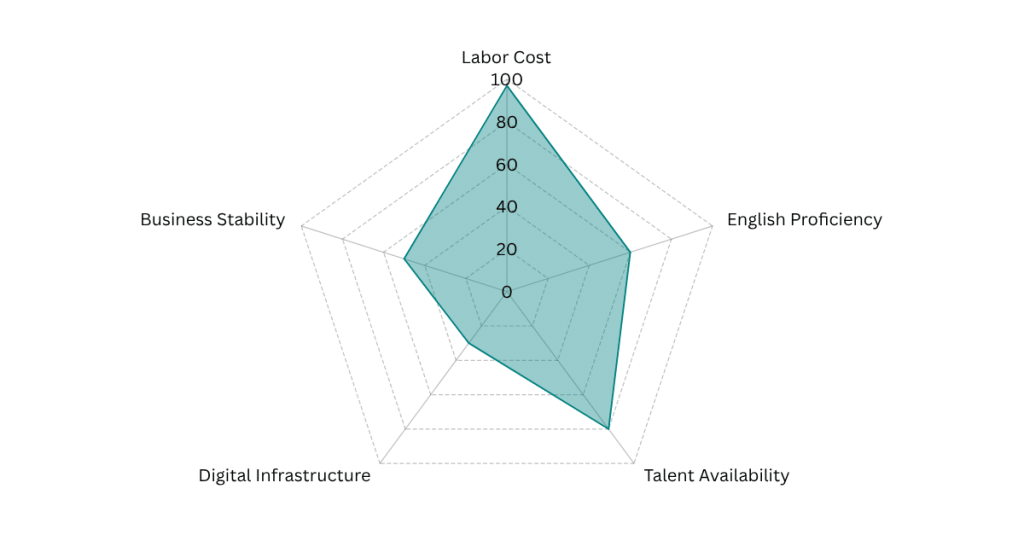
Pakistan is rapidly emerging as a high-value destination in the global outsourcing landscape, primarily driven by its exceptional Labor Cost Analysis and a massive, young talent pool. While the country offers significant cost advantages, it is currently balancing growth against challenges in digital infrastructure and political stability.
Each country receives a 0–100 score per factor, weighted by importance. Scores are derived from publicly available datasets and expert interpretation, using sources such as LinkedIn, UNESCO, EF EPI, World Bank, and the International Telecommunication Union (ITU).
The index is comparative and neutral, designed to highlight relative strengths. The index is comparative and neutral, designed to highlight relative strengths rather than label any country as “good” or “bad.”
Labor Force
Pakistan possesses one of the world’s largest freelance and remote workforces, with over 85 million total individuals in the labor force and a rapidly growing professional presence of over 6 million searchable profiles on LinkedIn.
Educational Pipeline
The country produces approximately 445,000 graduates annually from over 260 universities. This includes a heavy focus on STEM and IT, with nearly 25,000 new IT and engineering professionals entering the market each year.
English Proficiency Ranking
Pakistan is ranked #67 globally and maintains a “Low Proficiency” status on the EF EPI. However, in urban hubs like Islamabad and Lahore, proficiency scores are significantly higher, making these cities the primary focus for international BPO operations.
Digital Infrastructure
Currently, 45.7% of the population (approximately 116 million people) is online. While urban centers benefit from 4G/5G and fiber-optic expansion, nationwide digital penetration remains a key area for development.
Time Zone: Pakistan Standard Time (PKT)
Current Local Time:
Pakistan is strategically positioned to provide 24/7 “follow-the-sun” support. Its 9-hour difference from U.S. Eastern Time allows for seamless overnight coverage for North American companies and real-time collaboration for Middle Eastern and European markets.

The Pakistani workforce is highly regarded for technical expertise and analytical tasks.
Commonly outsourced roles include:
These roles benefit from Pakistan’s focus on STEM education and a young, tech-savvy population that is increasingly aligned with international quality standards.
National holidays: Pakistan follows both a solar and a lunar calendar, meaning some religious dates shift annually. Key observances include:
Religion & customs: As an Islamic Republic, the month of Ramadan is significant. During this time, standard working hours are typically reduced by 2 hours daily to accommodate fasting.
Outsourcing work culture: Pakistan has a rapidly maturing remote work and outsourcing culture, driven by one of the world’s largest populations of digital freelancers. While the BPO sector is expanding, many professionals are already accustomed to “graveyard” shifts or flexible hours that align with U.S., European, and Middle Eastern business days. The workforce is highly adaptable to global team structures and is increasingly professionalized in remote collaboration.
Communication style: Generally formal and respectful. Building a personal rapport is often a precursor to a successful professional relationship. Clear, written instructions are preferred to avoid ambiguity.
Infrastructure variability: High-speed fiber-optic and 4G/5G connectivity are robust in major technology hubs like Islamabad, Lahore, and Karachi. However, reliability can decrease in smaller cities and rural districts. Periodic “load-shedding” (scheduled power outages) is a known factor that requires proactive management.
Monsoon & Seasonal Risks: Pakistan experiences a significant monsoon season, typically from July to September, which can lead to localized flooding and infrastructure stress.
Risk mitigation when hiring: Employers should prioritize candidates who demonstrate “operational redundancy,” including:
Business risk level: Moderate
Economic volatility and political transitions can create a complex operating environment. However, the IT and export-oriented services sector is highly prioritized by the government, offering various incentives for foreign employers.
Data & compliance: Pakistan is finalizing its National Personal Data Protection framework. Employers should align with international standards (like GDPR) and ensure remote staff use secure VPNs and encrypted hardware, particularly when handling sensitive financial or proprietary data.