
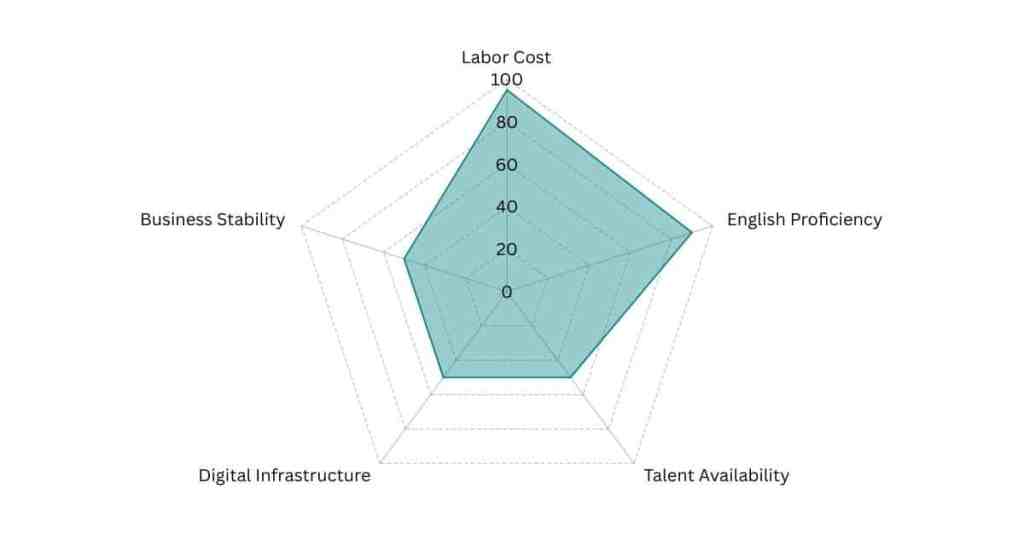
Kenya is emerging as a powerful alternative in the global outsourcing landscape, particularly noted for its exceptional labor cost efficiency and high English proficiency. As the “Silicon Savannah,” it offers a unique blend of technical aptitude and a rapidly maturing service culture that appeals to Western markets.
Each country receives a 0–100 score per factor, weighted by importance. Scores are derived from publicly available datasets and expert interpretation, using sources such as LinkedIn, UNESCO, the EF English Proficiency Index (EF EPI), World Bank, and the International Telecommunication Union (ITU).
The index is comparative and neutral, designed to highlight relative strengths rather than label any country as “good” or “bad.”
Labor Force
Kenya features an increasingly professionalized workforce with over 6.7 million searchable professionals on LinkedIn, representing a diverse pool of tech-savvy and service-oriented talent.
Educational Pipeline
The country produces a massive influx of skilled talent annually, with over 144,000 graduates from TVET institutions alone in 2024, supplemented by a steady stream of degree-holders from 60 universities. The curriculum is heavily shifting toward Competency-Based Education (CBET) to meet global demand for STEM and ICT skills.
English Proficiency Ranking
Ranked #3 in Africa and #19 globally in the 2025 EF English Proficiency Index, Kenya maintains a “High Proficiency” status. English is an official language and the primary medium of instruction in schools and business.
Digital Infrastructure
While 40.5% of the general population is online, urban centers like Nairobi and Mombasa boast high-speed fiber connectivity, supported by one of the world’s most advanced mobile money ecosystems (M-Pesa).
Time Zone: East Africa Time (EAT)
Current Local Time:
Kenya is ideally positioned for European time-aligned shifts (only 1–2 hours difference) and provides a strong “follow-the-sun” bridge for U.S. companies looking for evening or early morning coverage.

Kenya’s talent pool is particularly strong in technical, creative, and analytical roles. Commonly outsourced roles include:
Commonly outsourced roles include:
These roles take advantage of Kenya’s growing tech scene and its reputation as a top place in Africa for high-quality, English-speaking digital talent.
National holidays: Kenya observes several religious and national holidays that may impact business operations:
Religion & customs: Kenya is a diverse nation with a Christian majority and a significant Muslim minority. Respect for religious observances, particularly during Ramadan and Christmas, is central to workplace harmony.
Outsourcing work culture: Known for a “can-do” attitude and high resilience. While the BPO sector is younger than the Philippines’, Kenyan professionals are highly adaptable to global standards and are increasingly comfortable with 24/7 shift rotations.
Communication style: Communication is typically respectful and high-context. Building a personal rapport is often a prerequisite for a successful professional relationship. While generally direct in business, feedback is best delivered privately and constructively.
Infrastructure variability: Reliability is excellent in Nairobi’s business districts (Kilimani, Westlands), but occasional power fluctuations occur.
Rainy Seasons: Kenya typically experiences two distinct rainy seasons: the “Long Rains” (March to May) and the “Short Rains” (October to December).
Risk mitigation when hiring: Employers should screen for:
Business risk level: Moderate
While Kenya is a regional hub, investors should stay aware of the local regulatory environment and tax compliance requirements (such as KRA regulations).
Data & compliance: There is an increasing focus on the Kenya Data Protection Act. Companies should ensure that remote workers utilize VPNs and follow strict data handling protocols.