
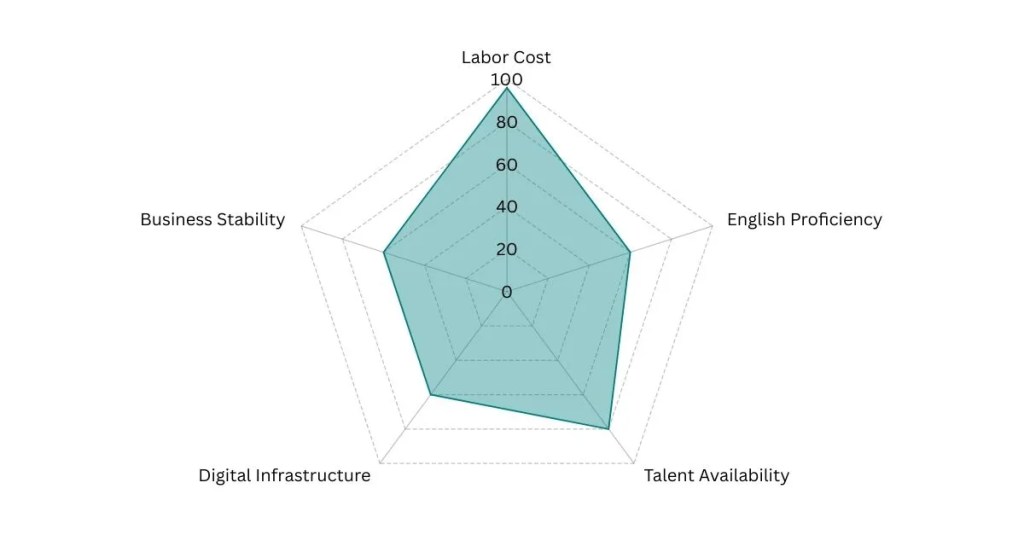
Indonesia ranks as a high cost-efficiency, large-scale talent market within the Global Outsourcing Talent Index. With a total score of 82.4, the country stands out primarily for its exceptional labor arbitrage (96/100) and broad university-educated workforce (80/100), balanced against moderate English proficiency (60/100), developing digital infrastructure (60/100), and moderate business/regulatory stability (60/100).
Each country receives a 0–100 score per factor, weighted by importance. Scores are derived from publicly available datasets and expert interpretation using sources such as LinkedIn, UNESCO, TOEFL / EF EPI, Gallup World Poll, ITU, Ookla, World Bank, World Economic Forum, and the Heritage Foundation.
The index is comparative and neutral. It highlights relative strengths and structural trade-offs rather than labeling any country as “good” or “bad.”
Time Zone:
Western Indonesia Time (WIB, UTC 7)
Central Indonesia Time (WITA, UTC 8)
Eastern Indonesia Time (WIT, UTC 9)
Current Local Time:
Indonesia is well positioned for Asia-Pacific coverage, Australian time alignment, and partial overlap with European mornings. U.S. alignment typically requires night shifts, which are increasingly common in digital and outsourcing roles, though not as culturally embedded as in mature BPO markets.

Indonesia’s labor cost advantage and large graduate base support a wide range of service and knowledge-based functions, particularly cost-sensitive operational roles.
Commonly outsourced roles include:
These roles benefit from Indonesia’s large tertiary enrollment base and competitive wage structure, particularly in major urban centers like Jakarta, Bandung, Surabaya, and Yogyakarta.
National holidays: Indonesia observes several major public holidays that may affect availability:
Eid al-Fitr (Lebaran) is the most operationally significant holiday period, often involving extended leave and nationwide travel.
Religion & customs: Indonesia is the world’s largest Muslim-majority country. Ramadan and Eid periods significantly influence working hours and availability.
Outsourcing work culture: Indonesia has a growing digital economy and startup ecosystem, but it does not have the same decades-long BPO maturity as markets like the Philippines or India. Night shifts are possible but may require stronger expectation-setting.
Communication style: Generally polite and indirect. Clear SOPs, structured onboarding, and documented KPIs help reduce ambiguity.
Infrastructure variability: Internet penetration is broad, but fixed broadband speeds and reliability vary by region. Major cities such as Jakarta and Surabaya offer relatively stable connectivity, while rural and island regions may experience lower speeds and occasional instability.
Geographic & Natural Risk: Indonesia is located in the Pacific “Ring of Fire” and is exposed to:
Business continuity planning is important for distributed teams.
Risk mitigation when hiring: Employers should screen for:
Business risk level: Moderate
Indonesia scores as moderate risk in business, legal, and political stability. Strengths include a large domestic economy, improving investment frameworks, and stable macroeconomic management. Considerations include regulatory complexity, bureaucratic friction, corruption concerns, and uneven judicial enforcement. These risks are generally manageable for remote-first, service-based engagements, particularly under contractor or EOR structures.
Data & compliance: Employers hiring in Indonesia should implement clear NDAs and IP ownership agreements, establish secure cloud-based workflows, and enforce role-based access controls to protect sensitive information. For regulated industries such as healthcare, finance, and legal services, additional industry-specific compliance oversight is strongly recommended. Indonesia’s digital governance framework continues to evolve, so maintaining strong internal compliance standards is essential, particularly when handling confidential or regulated data.