
Egypt is rapidly emerging as a top-tier destination for global outsourcing, primarily driven by its exceptional cost efficiency and a young, massive talent pool. With a strategic location bridging Europe, the Middle East, and Africa, Egypt offers a compelling value proposition for companies seeking high-quality technical and back-office support at a fraction of Western labor costs.
Each factor is scored from 0–100, weighted by its impact on remote operations. Data is synthesized from reputable global sources including the World Bank, ITU, EF Education First, and the Egyptian Ministry of Communications and Information Technology (MCIT).
The index is comparative and neutral, designed to highlight relative strengths rather than label any country as “good” or “bad.”
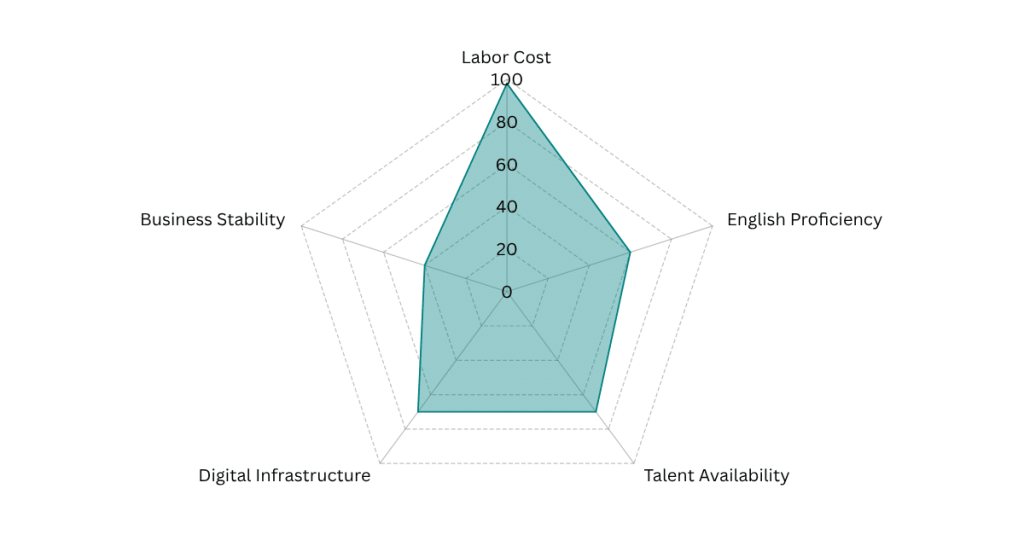
Labor Force
Egypt boasts a robust and expandable workforce with a total labor force of 34.8 million individuals, of which 32.6 million are actively employed. This talent pool is supported by a growing professional community of several million searchable profiles on LinkedIn.
Educational Pipeline
The country produces over 738,000 graduates annually from higher education institutions. A strong emphasis on STEM and language studies with significant clusters in business, law, and health ensures a steady stream of “work-ready” talent for the global market.
English Proficiency Ranking
Ranked #89 globally, Egypt maintains a “Low” to “Moderate” proficiency level. However, within the outsourcing sector (Cairo and Alexandria), proficiency is significantly higher, often reaching “High” status in specialized BPO hubs.
Digital Infrastructure
As of 2026, internet penetration has reached 82.7%, with 98.2 million users. The government’s “Digital Egypt” strategy has significantly boosted fixed broadband speeds, now averaging over 76 Mbps.
Time Zone: Eastern European Standard Time
Current Local Time:
Egypt is ideally positioned for European-aligned shifts (0–2 hour difference) and provides a strong base for “follow-the-sun” support for U.S. companies, particularly for late-night and early-morning coverage.

Egypt’s talent pool is particularly strong in technical fields and multilingual support (English, French, German, and Arabic).
Commonly outsourced roles include:
These roles leverage Egypt’s growing reputation for technical excellence and its status as a competitive, multilingual hub for the EMEA region.
National holidays: Egypt observes a mix of fixed secular holidays and lunar-based Islamic holidays. Key dates for 2026 include:
Religion & customs: Predominantly Muslim, with a significant Coptic Christian minority. Ramadan is a holy month where business hours are typically shortened, and productivity may shift to evening hours.
Outsourcing work culture: There is a high emphasis on hospitality and building strong personal relationships within professional circles. Under the New Labor Law No. 14 of 2025, the standard work week is capped at 48 hours, though a 40-hour week (Sunday–Thursday) is the common standard in the outsourcing and tech sectors. Professionals are entitled to 15–21 days of annual leave, which increases to 30 days after ten years of service.
Communication style: Egyptians value relationship-building and hospitality. Communication is often warm and expressive; however, clear KPIs and structured feedback are essential for maintaining alignment in remote settings.
Infrastructure variability: While fiber-optic coverage is excellent in “Smart Villages” and major hubs like Cairo, residential areas may still experience occasional power load-shedding or stability issues.
Heatwaves & Seasonal Dust Storms: Egypt is exposed to extreme summer heatwaves, typically from June to August, and seasonal dust storms (Khamasin), which generally occur between March and May
Risk mitigation when hiring: Employers should screen for:
Business risk level: Low to Moderate
Economic reforms and a massive push for digital exports have stabilized the environment, though investors should monitor currency volatility and regional geopolitical shifts. Regulatory complexity remains a factor, particularly regarding bureaucratic processes, but these are generally manageable for service-based and remote-first operations through the use of local partners or EORs.
Data & compliance: Employers must adhere to the Personal Data Protection Law (PDPL), which reaches full enforcement by October 2026. This requires strict standards for data collection, processing, and cross-border transfers, making it essential to establish clear security protocols for regulated industries such as healthcare and finance.