
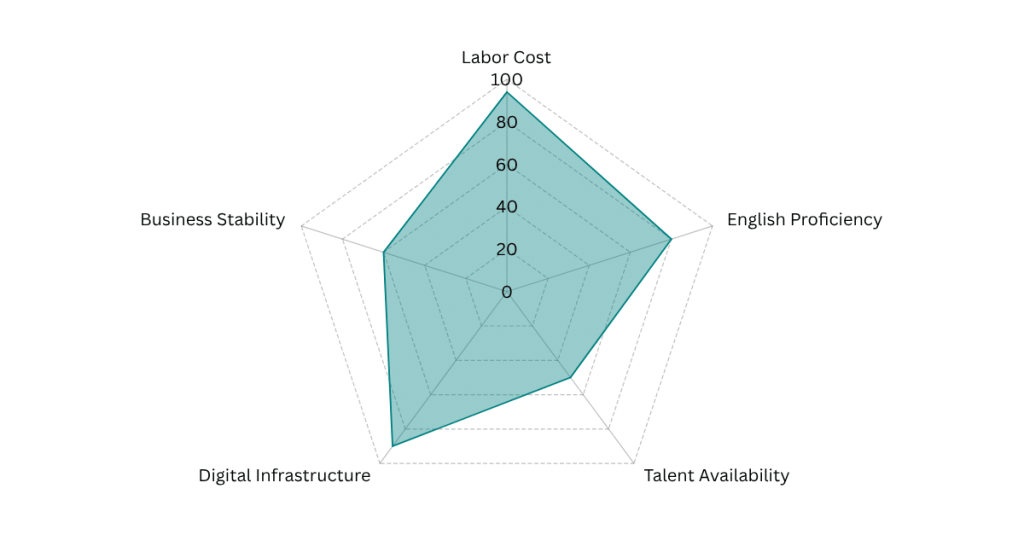
The Dominican Republic is a rapidly ascending nearshore outsourcing destination, distinguished by its exceptional labor cost efficiency and strategic proximity to the North American market. With a robust digital infrastructure and a maturing BPO sector, it offers a compelling alternative for companies seeking real-time collaboration within U.S. time zones.
Each country receives a 0–100 score per factor, weighted by importance. Scores are derived from publicly available datasets and expert interpretation, using sources such as LinkedIn, the World Bank, EF English Proficiency Index (EF EPI), DataReportal, and the Heritage Foundation.
The index is comparative and neutral, designed to highlight relative strengths rather than label any country as “good” or “bad.”
Labor Force
The Dominican Republic possesses a growing professional ecosystem, with approximately 1.1 million searchable profiles on LinkedIn, reflecting a workforce increasingly integrated into the global digital economy.
Educational Pipeline
With a tertiary enrollment rate of 58%, the country has one of the highest rates of higher education participation in the region, focusing heavily on business and tech-related degrees.
English Proficiency Ranking
Ranked #63 globally in the 2025 EF EPI, the Dominican Republic is classified as having “Moderate Proficiency” on a national average, yet it maintains high concentrations of bilingual talent in urban centers like Santo Domingo and Santiago.
Digital Infrastructure
91.0% of the population is online. The country has seen a 38% year-on-year increase in fixed internet speeds, making it one of the most connected nations in the Caribbean.
Time Zone: Atlantic Standard Time (AST)
Current Local Time:
The Dominican Republic operates in a time zone that aligns perfectly with the U.S. East Coast (matching EDT in the summer and remaining 1 hour ahead of EST in the winter). This makes it a premier “nearshore” location for real-time collaboration and “follow-the-sun” support without the need for extreme night shifts.

The DR’s BPO sector has evolved from basic call centers to high-value specialized services. Commonly outsourced roles include:
Commonly outsourced roles include:
These roles take advantage of the Dominican Republic’s maturing tech landscape and its reputation as a leading nearshore hub for high-quality, bilingual digital talent.
National holidays: The DR observes several religious and patriotic holidays that may impact operations:
Religion & customs: Predominantly Roman Catholic; religious holidays like Holy Week (Semana Santa) are significant, often involving travel and family gatherings.
Outsourcing work culture: Professionals are known for being warm, friendly, and service-oriented. Cultural affinity with the U.S. is high due to the large Dominican diaspora, leading to a “neutral” accent and high empathy in customer interactions.
Communication style: Communication is typically warm and relationship-driven. Building personal rapport is often a prerequisite for a successful professional relationship. While generally polite and indirect to maintain harmony, feedback is best delivered privately and constructively to ensure long-term trust.
Infrastructure variability: Connectivity is excellent in Santo Domingo and Santiago. While the 5G rollout is advanced, businesses should still verify local ISP stability in smaller towns.
Hurricane season: Like much of the Caribbean, the DR is active during the Atlantic hurricane season (June – November).
Risk mitigation when hiring: Employers should screen for:
Business risk level: Moderate
Political stability is high compared to regional peers, though bureaucratic “red tape” exists. Most BPO operations benefit from “Free Zone” regulations which streamline international business.
Data & compliance: There is an increasing focus on the Ley No. 172-13 regarding Personal Data Protection. Companies should ensure that remote workers utilize VPNs and follow strict data handling protocols to align with both local and international privacy standards.