
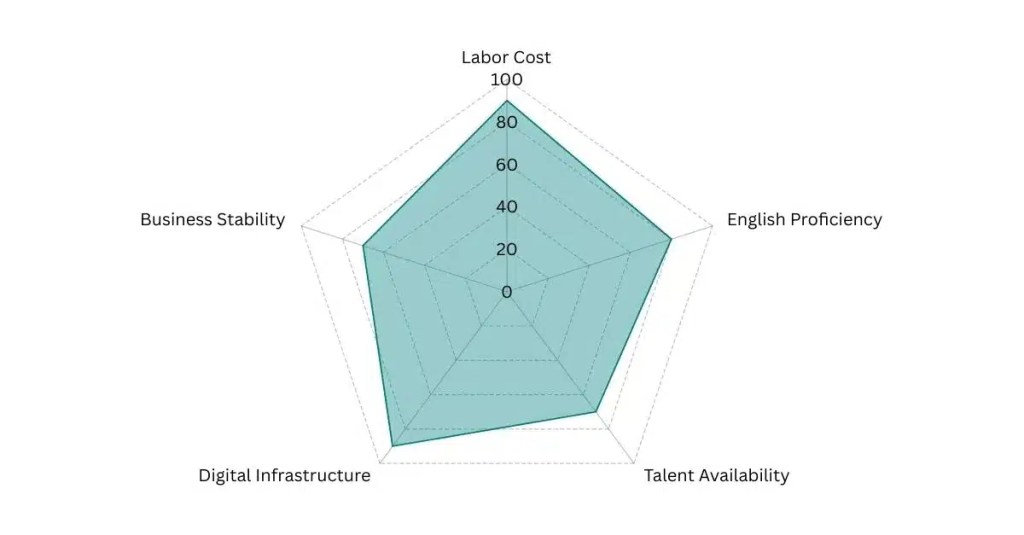
Chile ranks as a high-performing nearshore destination in the Global Outsourcing Talent Index due to its strong digital infrastructure, competitive labor costs relative to North America, and stable business environment within Latin America.
Each country receives a 0–100 score per factor, weighted by importance. Scores are derived from publicly available datasets and expert interpretation, using sources such as LinkedIn, UNESCO, TOEFL / EF EPI, Gallup World Poll, ITU, Ookla, World Bank, World Economic Forum, and the Heritage Foundation.
The index is comparative and neutral, designed to highlight relative strengths rather than label any country as “good” or “bad.”
Time Zone: Chile Standard Time (CLT)
Current Local Time:
Chile is particularly well suited for U.S. East Coast alignment, offering a strong nearshore advantage with real-time collaboration across North America. Unlike offshore Asia-based teams, Chile enables true real-time communication during standard U.S. working hours, significantly reducing handoff delays and overnight lag.

Chile’s outsourcing ecosystem supports a mix of professional, technical, and operations-based roles, particularly those requiring real-time collaboration and stable infrastructure.
Commonly outsourced roles include:
These roles benefit from Chile’s high tertiary education participation, strong urban infrastructure, and proximity to U.S. time zones.
National holidays: Chile observes several national holidays that may affect availability if not planned for:
Regional holidays may also apply.
Religion & customs: Chile is predominantly Christian (largely Catholic), and Independence Day celebrations in September are culturally significant and often involve extended festivities.
Outsourcing work culture: Chile reflects a professional, Western-aligned corporate environment with strong adoption of remote and hybrid work models. The country also has a growing startup and technology ecosystem, particularly in Santiago, which continues to attract skilled professionals and international collaboration.
Communication style: Typically direct yet professional, with a strong emphasis on structure, accountability, and clear documentation. Communication tends to be straightforward and business-focused, especially in corporate and technical environments, while still maintaining a respectful and formal tone.
Infrastructure variability: Chile benefits from high internet penetration, some of the fastest fixed broadband speeds globally, and strong urban fiber infrastructure. Connectivity is highly reliable in major metropolitan areas such as Santiago, Valparaíso, and Concepción, where most of the country’s professional talent is concentrated. While connectivity in rural or remote regions may vary, the majority of outsourcing and knowledge-based roles are based in well-connected urban centers, reducing operational risk for remote teams.
Natural risk exposure: Chile is located along the Pacific “Ring of Fire” and has historically experienced significant seismic activity, making it earthquake-prone. However, the country is widely recognized for strict building codes, resilient infrastructure, and well-developed disaster response systems that mitigate disruption risk. Unlike tropical regions, Chile is not exposed to typhoons or hurricanes, which reduces the likelihood of prolonged weather-related business interruptions.
Risk mitigation when hiring: Employers should screen for:
Business risk level: Moderate
Chile is widely regarded as one of the most stable business environments in Latin America, though regulatory processes can be formal and compliance-driven. Labor protections are stronger than in some emerging markets, and recent political reforms have led to periods of policy debate and adjustment. Despite this, property rights are well established, financial systems are stable, and market institutions are mature and functional. For service-based and remote-first operations, overall risk remains manageable and relatively predictable.
Data & compliance: Chile has established data protection regulations and comparatively strong digital governance within the region. For regulated industries such as healthcare, finance, and legal services, employers should implement formal data security policies, require secure home office setups, establish clear confidentiality agreements, and use encrypted collaboration tools to maintain compliance and protect sensitive information.