
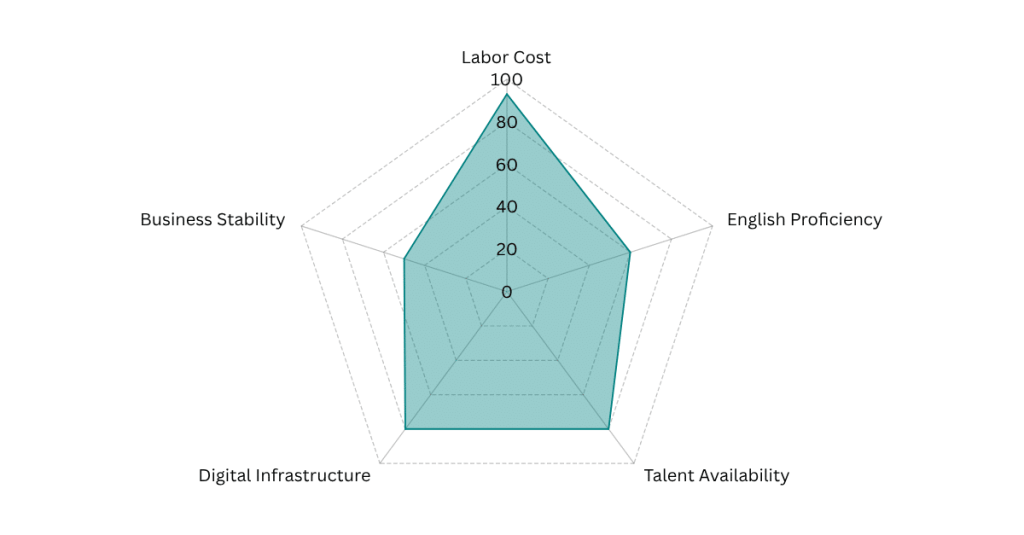
Brazil is rapidly emerging as a premier nearshore destination for North American companies, offering a compelling combination of high-value labor costs and a massive, digitally-savvy talent pool. While its English proficiency and regulatory stability present unique hurdles, Brazil’s alignment with U.S. time zones and its sophisticated tech ecosystem make it a strategic choice for complex engineering and creative roles.
Each country receives a 0–100 score per factor, weighted by importance. Scores are derived from publicly available datasets and expert interpretation, using sources such as LinkedIn, UNESCO, EF EPI, World Bank, and the OECD.
The index is comparative and neutral, designed to highlight relative strengths rather than label any country as “good” or “bad.”
Labor Force
Brazil boasts one of the largest professional networks in Latin America, with over 108 million active individuals in the labor force and a robust, searchable presence on LinkedIn for white-collar roles.
Educational Pipeline
While the young adult attainment rate of 24% is below the OECD average, Brazil offers a highly specialized talent pool for business operations. Notably, 34% of bachelor’s students graduate in Business, Administration, and Law which is significantly higher than the 23% OECD average.
English Proficiency Ranking
Ranked #75 globally and categorized with “Low Proficiency,” Brazil’s English skills are highly concentrated in urban hubs like São Paulo and Brasília. While not a primary hub for basic voice support, it excels in “high-context” technical roles where bilingual talent is specialized.
Digital Infrastructure
Brazil is a global digital leader with 86.2% internet penetration (approx. 183 million users). It has a median fixed internet download speed of 183.56 Mbps
Time Zone: Brasília Time (BRT) – typically UTC-3 Acre Time (ACT), Amazon Time (AMT), and Fernando de Noronha Time (FNT).
Current Local Time:
Brazil is exceptionally well-suited for nearshore collaboration with North American teams. Its primary business hubs are only 1–2 hours ahead of Eastern Standard Time (EST), allowing for full-day real-time synchroniza

Brazil’s ecosystem is moving toward high-end technical and creative services. The workforce is known for being “super-technological” and highly adaptable.
Commonly outsourced roles include:
These roles take advantage of Brazil’s sophisticated tech ecosystem and its reputation as a premier “nearshore” hub for high-quality, adaptable digital talent in the Western Hemisphere.
National holidays: Brazil has a robust calendar of mandatory holidays. If these fall on a Tuesday or Thursday, “enforcado” (bridging) the holiday to the weekend is a common cultural practice.
Religion & customs: While predominantly Catholic, Brazil’s work culture is defined by “Relacionamento” (Relationship-first). Building trust through small talk and personal rapport is essential before diving into technical tasks.
Outsourcing work culture: Known for a can-do attitude and the jeitinho brasileiro. A resourceful, creative approach to problem-solving. Brazilian professionals prioritize building strong interpersonal relationships and trust, which translates into highly collaborative and loyal teams.
Communication style: Communication is often indirect and diplomatic. Brazilians may avoid a direct “no” to maintain harmony. Expressive body language and passion are standard; silence in a meeting often indicates a lack of engagement rather than agreement.
Infrastructure variability: While urban centers have world-class fiber internet, rural areas can be inconsistent. Recife and Florianópolis are top-tier tech hubs with resilient infrastructure, whereas the Amazonian regions face higher environmental and connectivity stress.
Environmental factors: Heavy summer rains (Dec–Mar) can cause localized flooding and power outages in coastal cities like Rio de Janeiro and Recife.
Risk mitigation when hiring: Employers should screen for:
Business risk level: Moderate
Brazil has highly protective and complex labor laws. Most international companies use an Employer of Record (EOR) to manage payroll, FGTS (severance fund), and 13th-month salary requirements.
Data & compliance: Brazil’s LGPD is very similar to Europe’s GDPR. Companies must ensure local data processing meets these stringent privacy standards.